Chul-Hyun Myung  1,† , Tae-Wook Kim 2,† , Sa-Hyun Lee 2 , Doo-Ha Yang 2 , Hyun-Tae Lim 1,3,* , Sang-Hyun Han 2,*
1Division of Animal Science, College of Agriculture and Life Science, Gyeongsang National University, Jinju 52725, Republic of Korea
2National Park Institute for Wildlife Conservation, Korea National Park Service, Gurye 57616, Republic of Korea
3Institute of Agriculture and Life Science, Gyeongsang National University, Jinju 52828, Republic of Korea
†These authors contributed equally to this work and share first authorship.
*Corresponding authors: s_htim@gnu.ac.kr, hansh04@knps.or.kr
Volume 10, Number 3, Pages 185–192, September 2026.
Journal of Animal Breeding and Genomics 2026, 10(3), 185–192. https://doi.org/10.12972/jabng.2026.10.3.8
Received on September 01, 2026, Revised on September 29, 2026, Accepted on September 29, 2026, Published on September 30, 2026.
Copyright © 2026 Korean Society of Animal Breeding and Genetics.
This is an Open Access article distributed under the terms of the Creative Commons Attribution Non-Commercial License (https://creativecommons.org/licenses/by-nc/4.0/) which permits unrestricted non-commercial use, distribution, and reproduction in any medium, provided the original work is properly cited.

Asiatic black bear, multiple paternity, parentage, pedigree
Information on mating systems and reproductive biology is essential for understanding the behavioral ecology of wildlife and developing effective conservation and management strategies. Mammals exhibit a wide range of mating systems, including monogamy, polygyny, polyandry, and polygynandry (Stockley, 2003; Steyaert et al., 2012; Dobson et al., 2018). In many mammalian species, individuals may mate with multiple partners within a single breeding season. Multiple paternity, which occurs when offspring within a single litter are sired by more than one male, is a consequence of female mating with multiple males. This reproductive strategy increases genetic diversity among offspring and reduces genetic relatedness among siblings within a litter. Such effects may enhance the fitness of wildlife populations in changing environments (Charmantier et al., 2004; Arnett et al., 2008; Bennett and Hale, 2014; Gayet et al., 2016; Ammerman et al., 2019). Previous studies have suggested that the occurrence of multiple paternity may be influenced by several ecological factors, including population density and sex ratio (Baker et al., 1999; Say et al., 1999; Burton, 2002; Kokko and Rankin, 2006; Ishibashi and Saitoh, 2008).
Bears have complex mating behaviors, and females may mate with multiple males during a single breeding season (Craighead et al., 1995; Bellemain et al., 2006; Zeyl et al., 2009; Shimozuru et al., 2019). In several bear species, adult males generally have larger home ranges than females, and the spatial overlap between male and female home ranges, together with increased male mobility during the breeding season, may facilitate encounters with potential mates (Dahle and Swenson, 2003; Koehler and Pierce, 2003). Both male and female bears may mate with multiple partners, with estimates ranging from three to eight mating partners during a single breeding season in some populations (Craighead et al., 1995; Schenk and Kovacs, 1995; McLellan and Hovey, 2001). Female bears generally show not only repeated estrous and ovulatory events during a breeding season, but also exhibit delayed implantation in which embryonic development is temporarily suspended before implantation in the uterus, allowing reproduction to be synchronized with seasonal conditions and maternal energy requirements associated with hibernation (Wimsatt, 1963; Sato et al., 2001; Chang et al., 2011; Huang et al., 2012; Steyaert et al., 2012; Himelright et al., 2014). The combination of multiple mating, repeated reproductive events, and delayed implantation may provide opportunities for multiple paternity in bears (Craighead et al., 1995; Bellemain et al., 2006; Spady et al., 2007; Chang et al., 2011; Himelright et al., 2014). Molecular evidence of multiple paternity has been documented in several bear species, including the American black bear (Ursus americanus), brown bear (U. arctos), polar bear (U. maritimus) and Japanese black bear (U. thibetanus japonicus) (Schenk and Kovacs, 1995; Kovach and Powell, 2003; Bellemain et al., 2006; Zeyl et al., 2009; Yamamoto et al., 2012; Shimozuru et al., 2019).
During the twentieth century, Asiatic black bear (U. thibetanus ussuricus) populations in South Korea declined substantially, along with those of other large carnivores, including tigers, leopards, and wolves. This decline was associated with extensive hunting under the policy of exterminating harmful wild animals during the Japanese colonial period (1910–1945), the Korean War (1950–1953), and subsequent industrialization and habitat changes (Kim et al., 2011; Hyun et al., 2022). These historical pressures contributed to severe population declines and increased the risk of local extinction for several native carnivore species. In response, a restoration project for the Asiatic black bear was initiated in South Korea in 2004. Since then, the population has increased through the release of bears reintroduced from overseas and those bred in captivity, as well as through natural reproduction in the wild (Lee and Jeong, 2009; Kim et al., 2011; Hyun et al., 2022).
Despite the progress of the Asiatic black bear restoration project, information on the reproductive ecology of the population, particularly the occurrence of multiple paternity, remains limited. Understanding multiple paternity can provide valuable insights into mating patterns and reproductive dynamics and contribute to the genetic management of this population. Therefore, this study investigated the occurrence of multiple paternity in the wild population of Asiatic black bears in Jirisan National Park and its surrounding areas, South Korea, using parentage analysis based on microsatellite genotypes.
A total of 122 Asiatic black bears were used in this study. Of these, 52 bears (28 females and 24 males) had been reintroduced from overseas populations in northeastern China, the Russian Far East, and North Korea. The remaining 70 bears consisted of nine bears born in breeding facilities and 61 individuals born in the wild. Samples of blood (n = 140), tissue (n = 5), hairs (n = 68), and feces (n = 21) were collected from bears captured in the wild in Jirisan National Park and its surrounding areas, South Korea, between March 2012 and December 2025. In addition, blood samples from 52 reintroduced Asiatic black bears were included in the genetic analyses. Genomic DNA was extracted from blood and tissue samples using the DNeasy Blood & Tissue Kit (Qiagen, Hilden, Germany), from hair samples using the QIAamp DNA Micro Kit (Qiagen, Hilden, Germany), and from fecal samples using the QIAamp PowerFecal DNA Kit (Qiagen, Hilden, Germany). DNA concentration and purity were assessed using a DS-11 UV/Vis Spectrophotometer (DeNovix, USA). The extracted DNA was used as a template for polymerase chain reaction (PCR).
Twenty microsatellite markers previously reported for Asiatic black bears by Myung et al. (2025) were used for pedigree reconstruction. The markers were fluorescently labeled at the 5′ ends with FAM, VIC, NED, or PET dyes to enable multiplex PCR and subsequent genotyping. PCR amplification was performed using a Mastercycler Nexus Gradient thermal cycler (Eppendorf, Germany) in a 10-µL reaction volume containing Multiplex PCR Mix (Qiagen, Hilden, Germany), following the PCR conditions described by Myung et al. (2025). The amplified PCR products were separated using an ABI Prism 3730XL DNA Analyzer (Applied Biosystems, Foster City, CA, USA), and allele sizes were determined using GeneMapper software (Applied Biosystems, Foster City, CA, USA). To minimize genotyping errors, each sample was genotyped at least three times.
Individual bears were identified using multilocus genotypes based on 20 microsatellite loci by Identity test using CERVUS version 3.0.6 (Kalinowski et al., 2007), and samples sharing the identical genotypes at all loci genotyped were considered to be the same individual. Parentage analysis was conducted to assign candidate parents to each offspring using CERVUS. Adult bears older than three years were considered potential parents, resulting in 54 candidate mothers and 63 candidate fathers. Parentage assignments were evaluated using the likelihood-based approach implemented in CERVUS, and parent-offspring trios were accepted when the assignment confidence level exceeded 95%. A pedigree was subsequently constructed based on the parentage analysis results. Multiple paternity was identified when offspring within the same litter were assigned to different biological fathers in a single breeding season.
Based on the microsatellite genotypes, a pedigree was constructed for nine bears born in breeding facilities and 61 wild-born cubs and their parents from 51 litters in the Asiatic black bear population (Figure 1). The pedigree revealed complex mating patterns, including monogamy, polygyny, and polyandry. Multiple paternity was identified in three independent litters with two cubs in a single breeding season (Figure 2). These cases involved offspring of females F-18 and F-27 in 2012 and female F-23 in 2014. Female F-18 produced two cubs, M-42 and M-55, in 2012, which were assigned to different fathers, M-02 and M-19, respectively (Figure 2A). Similarly, female F-27 produced two cubs, M-1203 and M-1204, in 2012, which were assigned to M-02 and M-19, respectively (Figure 2B). The third case involved female F-23, which produced two cubs, F-58 and F-59, in 2014, assigned to different fathers, M-14 and M-30, respectively (Figure 2C).
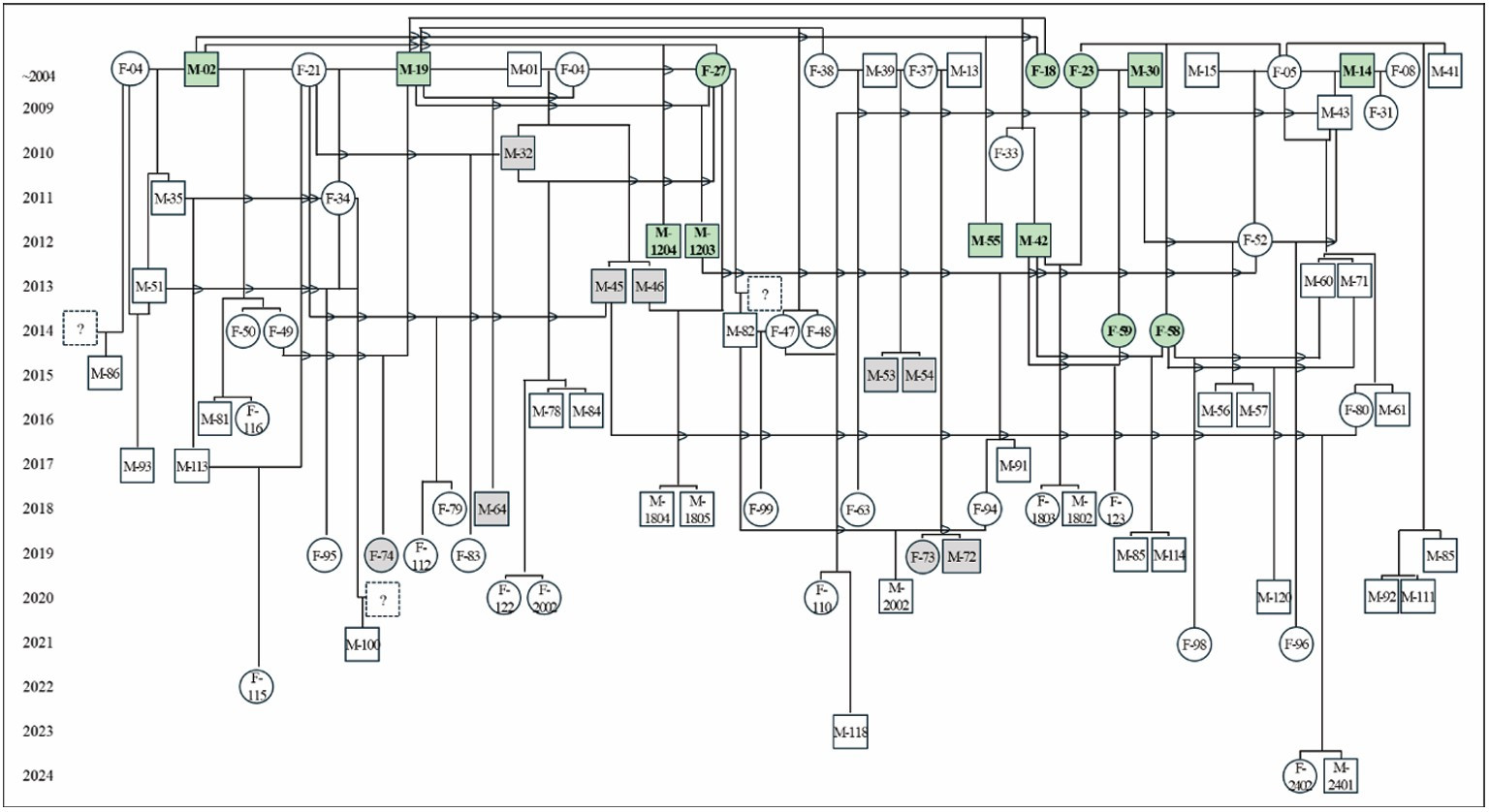
Figure 1. Pedigree of the reintroduced Asiatic black bear population in South Korea. The pedigree illustrates the relationships between bear cubs and their parents, as determined by parentage analysis using microsatellite genotypes. Squares and circles represent males and females, respectively. Gray symbols indicate cubs born in captivity through human-assisted reproduction. Green symbols with bold labels indicate cubs and their parents involved in multiple paternity cases. The squares marked with a question mark in a dotted line represent unidentified father bears. Numbers along the left margin indicate the estimated birth years of the bears. Thirty- three reintroduced bears that had produced no offspring were excluded from the pedigree illustration.
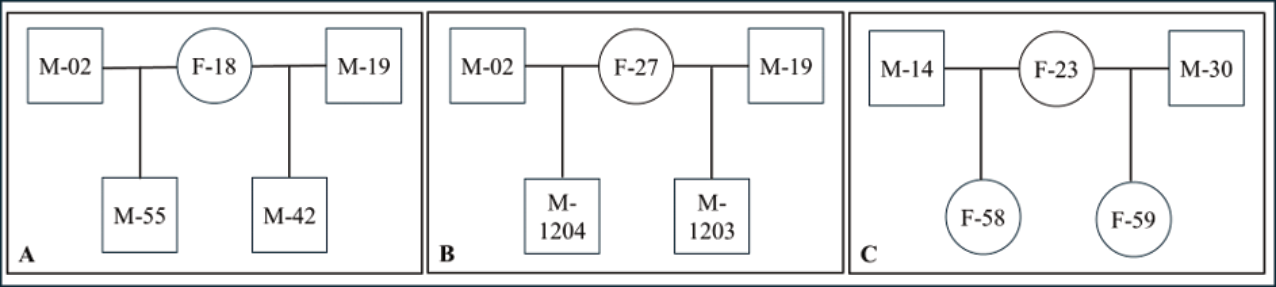
Figure 2. Pedigrees illustrating multiple paternity cases identified in the wild Asiatic black bear population. The parents of wild-born cubs were assigned through parentage analysis using microsatellite genotypes. (A) The family of female F-18, whose two cubs (M-42 and M-55), born in 2012, were sired by M-02 and M-19. (B) The family of female F-27, whose two cubs (M-1203 and M-1204), born in 2012, were sired by M-02 and M-19. (C) The family of female F-23, whose two cubs (F-58 and F-59), born in 2014, were sired by M-14 and M-30.
In this study, molecular parentage analysis identified three cases of multiple paternity in the reintroduced Asiatic black bear population in South Korea. Multiple paternity has also been documented in several other bear species, including American black bears (Schenk and Kovacs, 1995; Kovach and Powell, 2003), brown bears (Bellemain et al., 2006; Shimozuru et al., 2019), polar bears (Zeyl et al., 2009), and Japanese black bears (Yamamoto et al., 2012). These findings indicate that multiple paternity occurs across several bear species. The occurrence of multiple paternity varies considerably among mammals. Previous studies have reported low or absent multiple paternity in some species, such as wolverines and white-toothed shrews, whereas high frequencies have been documented in species such as honey possums and Mexican ground squirrels (Bouteiller and Perrin, 2000; Wooller et al., 2000; Hedmark et al., 2007; Schwanz et al., 2016). This variation suggests that multiple paternity may be influenced by differences in mating systems, reproductive biology, and ecological conditions among species. In bears, multiple paternity has been associated with multiple mating during the breeding season, which generally extends from spring to summer or autumn depending on the species, as well as with reproductive characteristics such as delayed implantation (Craighead et al., 1995; Sato et al., 2001; Spady et al., 2007; Chang et al., 2011; Steyaert et al., 2012). Multiple mating may increase the number of potential sires within a litter and thereby increase genetic diversity among siblings. Consequently, multiple paternity may reduce genetic relatedness among littermates and increase within-litter genetic diversity (Arnett et al., 2008; Ammerman et al., 2019). Such genetic variation may potentially contribute to offspring fitness and population adaptability under changing environments (Charmantier et al., 2004; Bennett and Hale, 2013; Gayet et al., 2016). These potential benefits may be particularly relevant to threatened populations, such as the Asiatic black bear, in which maintaining genetic diversity is an important component of conservation and population management (Gladstone, 1979; Walker, 1980; Schenk and Kovacs, 1995).
Multiple paternity was detected in three of the 19 litters with two cubs, corresponding to an occurrence rate of 15.8%. This rate is within the range reported for other bear populations, including Scandinavian brown bears (14.5%; Bellemain et al., 2006) and Japanese black bears (14.6– 17.1%; Shimozuru et al., 2019). In Arctic grizzly bears, multiple paternity was reported in approximately one-third of known litters containing two or more cubs (Craighead et al., 1995). In polar bears, multiple paternity was detected in two of 29 litters containing two or more cubs (6.9%; Zeyl et al., 2009). Differences in the reported occurrence rates among bear populations may reflect variation in reproductive behavior, ecological conditions, population characteristics, and sampling or analytical methods. Previous studies have suggested that the occurrence of multiple paternity may be associated with ecological and demographic factors, including population density and sex ratio (Baker et al., 1999; Say et al., 1999; Burton, 2002; Kokko and Rankin, 2006; Ishibashi and Saitoh, 2008). For example, in swift foxes, mating systems have been reported to vary with population density, with polygyny observed in high-density groups and monogamy in low-density areas (Kamler et al., 2004). These findings suggest that population density may influence mating opportunities and reproductive strategies, although the relationship may differ among species. The occurrence rate of multiple paternity observed in the present study was comparable to those reported in several other bear populations. However, the current sample size and the limited number of multiple-paternity cases do not allow us to determine whether population density, sex ratio, habitat area, or mating competition influence the occurrence of multiple paternity in the South Korean Asiatic black bear population. Further studies incorporating larger sample sizes and long-term ecological monitoring are therefore needed to investigate the potential relationships between multiple paternity and ecological or demographic factors in this population.
Although the ecological and evolutionary significance of multiple paternity is not yet fully understood, previous studies have suggested that its occurrence in mammals may be influenced by the population density, anthropogenic mortality and other ecological factors during the breeding season. In the present study, multiple paternity was detected in three litters with two cubs in the Asiatic black bear population in South Korea. The relatively large wild population, which comprised over 90 bears as of August 2026, together with limited habitat availability and potential mating competition, may influence mating opportunities and reproductive patterns in this population. However, the present study does not provide sufficient evidence to establish a direct relationship between these factors and the occurrence of multiple paternity. Further research involving larger sample sizes and additional field data is therefore needed to clarify the ecological and demographic factors associated with multiple paternity. To our knowledge, this study provides the first molecular evidence of multiple paternity in the Asiatic black bear population in South Korea. Further studies integrating genetic, spatial, and ecological data will be essential to elucidate the relationships between reproductive patterns, population characteristics, and environmental conditions. The findings of this study provide valuable baseline information for understanding the reproductive ecology of wild Asiatic black bears and may contribute to the development of effective habitat and population management strategies and conservation policies aimed at establishing a genetically viable and self-sustaining population beyond the restoration phase.
We truly thank anonymous participants and NPIWC staffs for sample collection, experimental support, and field investigation.
Conceptualization: Myung CH, Kim TW, Lim HT, Han SH. Data curation: Myung CH, Kim TW. Formal analysis: Kim TW, Lee SH, Yang DH, Han SH. Methodology: Myung CH, Kim TW, Han SH. Writing – original draft: Myung CH, Kim TW. Writing – review & editing: Han SH, Lim HT. Supervision: Han SH. Funding acquisition: Han SH, Lee SH, Yang DH. All authors read and approved the final manuscript.
No potential conflict of interest relevant to this article is reported.
Ethical approval for the study was granted by the Institutional Animal Care and Use Committee of the National Park Institute for Wildlife Conservation (NPIWC-R-20260223-1). All animal procedures complied with the NPIWC Guidelines for the Care and Use of Animals and adhered to the ethical standards set by the committees.
This work was carried out with the support of the Endangered Asiatic Black Bear Restoration Project of the National Park Institute for Wildlife Conservation of the Korea National Park Service and the Ministry of Environment, Republic of Korea.
We did not use generative artificial intelligence tools in the creation of this manuscript. All research, writing, and revisions are our own work.
Ammerman LK, Lee DN, Jones BA, et al. 2019. High frequency of multiple paternity in eastern red bats, Lasiurus borealis, based on microsatellite analysis. Journal of Heredity 110:675–683. https://doi.org/10.1093/jhered/esz044
Arnett EB, Brown WK, Erickson WP, et al. 2008. Patterns of bat fatalities at wind energy facilities in North America. Journal of Wildlife Management 72:61–78. https://doi.org/10.2193/2007-221
Baker RJ, Makova KD, Chesser RK. 1999. Microsatellites indicate a high frequency of multiple paternity in Apodemus (Rodentia). Molecular Ecology 8:107–111. https://doi.org/10.1046/j.1365-294X.1999.00541.x
Bellemain E, Zedrosser A, Manel S, et al. 2006. The dilemma of female mate selection in the brown bear, a species with sexually selected infanticide. Proceedings of the Royal Society B: Biological Sciences 273:283–291. https://doi.org/10.1098/rspb.2005.3331
Bennett VJ, Hale AM. 2014. Red aviation lights on wind turbines do not increase bat–turbine collisions. Animal Conservation 17:354–358. https:// doi.org/10.1111/acv.12102
Bouteiller C, Perrin N. 2000. Individual reproductive success and effective population size in the greater white-toothed shrew Crocidura russula. Proceedings of the Royal Society B: Biological Sciences 267:701–705. https://doi.org/10.1098/rspb.2000.1059
Burton C. 2002. Microsatellite analysis of multiple paternity and male reproductive success in the promiscuous snowshoe hare. Canadian Journal of Zoology 80:1948–1956. https://doi.org/10.1139/z02-187
Chang GR, Yang CC, Hsu SH, et al. 2011. Fecal reproductive steroid profiles for monitoring reproductive patterns in female Formosan black bears (Ursus thibetanus formosanus). Annales Zoologici Fennici 48:275–286. https://doi.org/10.5735/086.048.0502
Charmantier A, Blondel J, Perret P, et al. 2004. Do extra-pair paternities provide genetic benefits for female blue tits Parus caeruleus? Journal of Avian Biology 35:524–532. https://doi.org/10.1111/j.0908-8857.2004.03296.x
Craighead L, Paetkau D, Reynolds HV, et al. 1995. Microsatellite analysis of paternity and reproduction in Arctic grizzly bears. Journal of Heredity 86:255–261. https://doi.org/10.1093/oxfordjournals.jhered.a111578
Dahle B, Swenson JE. 2003. Seasonal range size in relation to reproductive strategies in brown bears Ursus arctos. Journal of Animal Ecology 72:660–667. https://doi.org/10.1046/j.1365-2656.2003.00737.x
Dobson FS, Abebe A, Correia HE, et al. 2018. Multiple paternity and number of offspring in mammals. Proceedings of the Royal Society B: Biological Sciences 285:20182042. https://doi.org/10.1098/rspb.2018.2042
Gayet T, Devillard S, Gamelon M, et al. 2016. On the evolutionary consequences of increasing litter size with multiple paternity in wild boar (Sus scrofa scrofa). Evolution 70:1386–1397. https://doi.org/10.1111/evo.12949
Gladstone DE. 1979. Promiscuity in monogamous colonial birds. American Naturalist 114:545–557. https://doi.org/10.1086/283501
Hedmark E, Persson J, Segerström P, et al. 2007. Paternity and mating system in wolverines Gulo gulo. Wildlife Biology 13(Suppl 2):13–30. https:// doi.org/10.2981/0909-6396(2007)13%5B13:PAMSIW%5D2.0.CO;2
Himelright BM, Moore JM, Gonzales RL, et al. 2014. Sequential ovulation and fertility of polyoestrus in American black bears (Ursus americanus). Conservation Physiology 2:cou051. https://doi.org/10.1093/conphys/cou051
Huang Y, Zhang H, Li D, et al. 2012. Relationship of the estrogen surge and multiple mates to cub paternity in the giant panda (Ailuropoda melanoleuca): Implications for optimal timing of copulation or artificial insemination. Biology of Reproduction 87:112. https://doi.org/10.1095/ biolreprod.112.102970
Hyun JY, Kim TW, Pandey P, et al. 2022. Molecular identification of archaic bones as a native Korean black bear: Implications for the ongoing bear restoration program. Animal Cells and Systems 26:214–222. https://doi.org/10.1080/19768354.2022.2112755
Ishibashi Y, Saitoh T. 2008. Effect of local density of males on the occurrence of multiple mating in gray-sided voles (Myodes rufocanus). Journal of Mammalogy 89:388–397. https://doi.org/10.1644/07-MAMM-A-036.1
Kalinowski ST, Taper ML, Marshall TC. 2007. Revising how the computer program CERVUS accommodates genotyping error increases success in paternity assignment. Molecular Ecology 16:1099–1106. https://doi.org/10.1111/j.1365-294X.2007.03089.x
Kamler JF, Ballard WB, Lemons PR, et al. 2004. Variation in mating system and group structure in two populations of swift foxes, Vulpes velox. Animal Behaviour 68:83–88. https://doi.org/10.1016/j.anbehav.2003.07.017
Kim YK, Hong YJ, Min MS, et al. 2011. Genetic status of Asiatic black bear (Ursus thibetanus) reintroduced into South Korea based on mitochondrial DNA and microsatellite loci analysis. Journal of Heredity 102:165–174. https://doi.org/10.1093/jhered/esq121
Koehler GM, Pierce DJ. 2003. Black bear home-range sizes in Washington: Climatic, vegetative, and social influences. Journal of Mammalogy 84:81–91. https://doi.org/10.1644/1545-1542(2003)084<0081:BBHRSI>2.0.CO;2
Kokko H, Rankin DJ. 2006. Lonely hearts or sex in the city? Density-dependent effects in mating systems. Philosophical Transactions of the Royal Society B: Biological Sciences 361:319–334. https://doi.org/10.1098/rstb.2005.1784
Kovach AI, Powell RA. 2003. Effects of body size on male mating tactics and paternity in black bears Ursus americanus. Canadian Journal of Zoology 81:1257–1268. https://doi.org/10.1139/z03-111
Lee BG, Jeong DH. 2009. Restoration of Asiatic black bears through reintroduction on Mt. Jiri, South Korea. International Bear News 18:8–10.
McLellan BN, Hovey FW. 2001. Natal dispersal of grizzly bears. Canadian Journal of Zoology 79:838–844. https://doi.org/10.1139/z01-051
Myung CH, Kim TW, Lee SH, et al. 2025. Novel microsatellite markers for identification of the Asiatic black bears being restored in South Korea. Journal of Agriculture & Life Science 59:83–89. https://doi.org/10.14397/jals.2025.59.1.83
Sato M, Tsubota T, Komatsu T, et al. 2001. Changes in sex steroids, gonadotropins, prolactin, and inhibin in pregnant and nonpregnant Japanese black bears (Ursus thibetanus japonicus). Biology of Reproduction 65:1006–1013. https://doi.org/10.1095/biolreprod65.4.1006
Say L, Pontier D, Natoli E. 1999. High variation in multiple paternity of domestic cats (Felis catus L.) in relation to environmental conditions. Proceedings of the Royal Society B: Biological Sciences 266:2071–2074. https://doi.org/10.1098/rspb.1999.0889
Schenk A, Kovacs KM. 1995. Multiple mating between black bears revealed by DNA fingerprinting. Animal Behaviour 50:1483–1490. https://doi.o rg/10.1016/0003-3472(95)80005-0
Schwanz LE, Sherwin WB, Ognenovska K, et al. 2016. Paternity and male mating strategies of a ground squirrel (Ictidomys parvidens) with an extended mating season. Journal of Mammalogy 97:576–588. https://doi.org/10.1093/jmammal/gyv204
Shimozuru M, Shirane Y, Tsuruga H, et al. 2019. Incidence of multiple paternity and inbreeding in high-density brown bear populations on the Shiretoko Peninsula, Hokkaido, Japan. Journal of Heredity 110:321–331. https://doi.org/10.1093/jhered/esz002
Spady TJ, Lindburg DG, Durrant BS. 2007. Evolution of reproductive seasonality in bears. Mammal Review 37:21–53. https://doi.org/10.1111/ j.1365-2907.2007.00096.x
Steyaert SMJG, Endrestøl A, Hackländer K, et al. 2012. The mating system of the brown bear Ursus arctos. Mammal Review 42:12–34. https:// doi.org/10.1111/j.1365-2907.2011.00184.x
Stockley P. 2003. Female multiple mating behaviour, early reproductive failure and litter size variation in mammals. Proceedings of the Royal Society B 270:271–278. https://doi.org/10.1098/rspb.2002.2228
Walker WF. 1980. Sperm utilization strategies in nonsocial insects. American Naturalist 115:780–799. https://doi.org/10.1086/283600
Wimsatt WA. 1963. Delayed implantation in the Ursidae, with particular reference to the black bear. In: Enders AC, editor. Delayed implantation. University of Chicago Press. pp. 49–76.
Wooller RD, Richardson KC, Garavanta CAM, et al. 2000. Opportunistic breeding in the polyandrous honey possum, Tarsipes rostratus. Australian Journal of Zoology 48:669–680. https://doi.org/10.1071/ZO00071
Yamamoto T, Tamatani H, Tanaka J, et al. 2012. Multiple paternity in Asian black bear Ursus thibetanus (Ursidae, Carnivora) determined by microsatellite analysis. Mammalia 77:215–217. https://doi.org/10.1515/mammalia-2012-0015
Zeyl E, Aars J, Ehrich D, et al. 2009. The mating system of polar bears: A genetic approach. Canadian Journal of Zoology 87:1195–1209. https:// doi.org/10.1139/Z09-107