 , Yoonji Chung2, Hayeong Oh1†, Seung Hwan Lee3*, Phuong Thanh N. Dinh1, JuHyeok Kim3, Namuk Kim3
Definition of the CWA-derived efficiency proxy trait for emission intensity
In this study, carcass weight by age (CWA) was used as the biological basis for deriving a carbon emission-related proxy trait. Following the logic described in Heo et al. (2025), CWA represents carcass output per unit of production time and reflects individual production efficiency. It was calculated as:
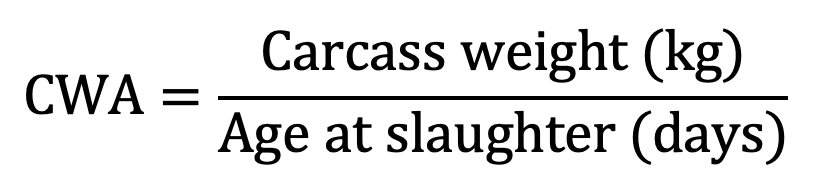
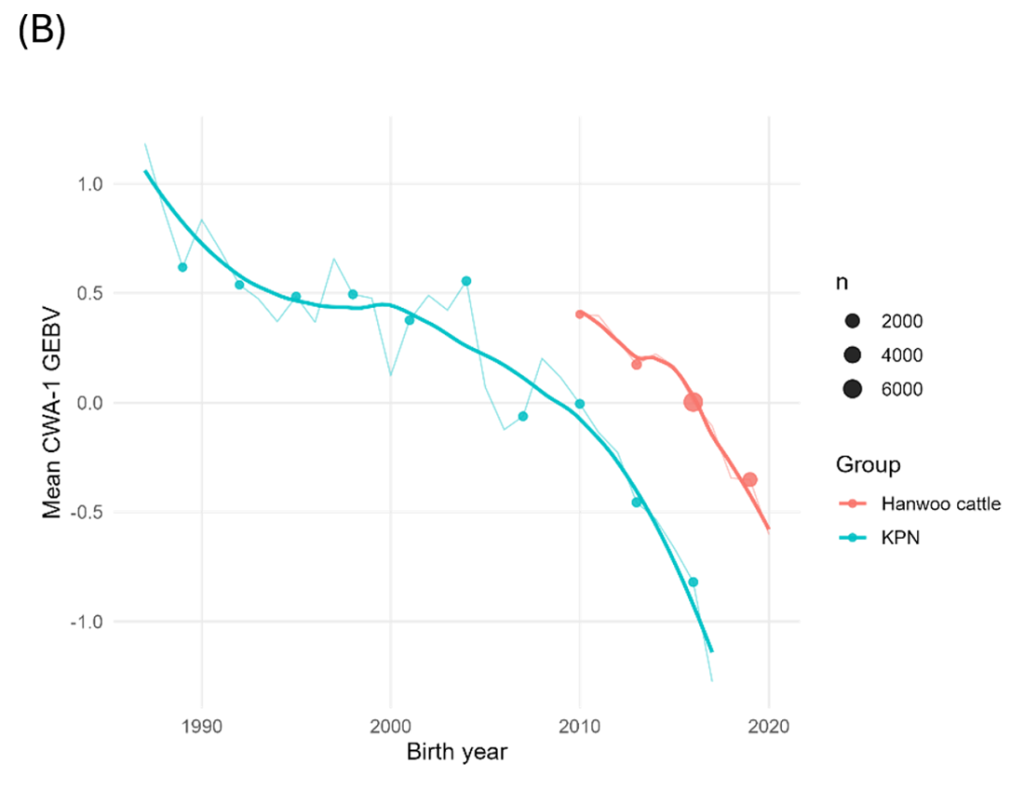
where carcass weight represents slaughter output and age at slaughter represents the total feeding or production period required to achieve that output. Animals with higher CWA values produce more carcass weight per unit time and are therefore interpreted as being more production efficient. Because emission intensity in beef systems is closely linked to the efficiency with which edible output is produced, a higher CWA corresponds to lower carbon burden per unit of production, whereas a lower CWA corresponds to a higher carbon burden. Based on this interpretation, the inverse of CWA was used in the present study as a carbon emission intensity-related phenotype. This trait was denoted as CWA-1. Biologically, this transformed trait represents the amount of time required per unit carcass output and can be interpreted as an indirect index of carbon emission intensity, where higher values indicate lower efficiency and potentially greater emission intensity per unit product (Heo et al., 2025). However, this trait should be interpreted as an indirect proxy based on production efficiency rather than a direct measure of methane emission, total greenhouse gas emission, feed intake, residual feed intake, or life-cycle carbon footprint.
A genomic relationship matrix was constructed using genome-wide SNP genotype information following the method of VanRaden (2008). In this approach, the genotype matrix is centered using allele frequencies, and genomic relationships are calculated so that realized genetic similarity among animals can be more accurately represented than with pedigree alone. Compared with the pedigree-based numerator relationship matrix, the genomic relationship matrix better captures Mendelian sampling and individual-specific allele sharing, which is particularly important for genomic evaluation of traits with complex inheritance (VanRaden, 2008).
If Z denotes the centered genotype matrix and pi denotes the allele frequency of the i-th marker, the genomic relationship matrix G was constructed using the standard VanRaden formulation:
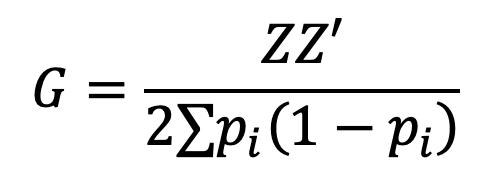
where the denominator scales the matrix using expected marker heterozygosity. This genomic relationship matrix was used in the mixed model framework for genomic evaluation and variance component estimation.
Genetic parameters for the carbon emission-related trait and conventional carcass traits were estimated using a linear mixed model. A framework was adopted because the carbon-related proxy trait is biologically related to growth and carcass performance, and joint analysis can improve estimation efficiency by accounting for genetic and residual covariance among traits. In Hanwoo, carcass traits such as CWT, EMA, BF, and MS are continuous quantitative traits, and therefore a linear mixed model is appropriate.
The general linear mixed model can be written as:
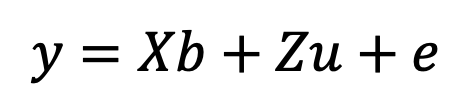
where y is the vector of phenotypic observations for all analyzed traits, b is the vector of fixed effects, u is the vector of random additive genetic effects, and e is the vector of residuals. X and Z are the corresponding incidence matrices relating observations to fixed and random effects, respectively. The fixed effects included birth year-month, slaughter year-month, and sex. Age at slaughter was not fitted as an additional fixed effect in the CWA-1 model because it was already included in the definition of the derived trait.
The assumed variance structure was:

where H is the pedigree-genomic relationship matrix, Σa is the additive genetic variance-covariance matrix among traits, Σe is the residual variance-covariance matrix among traits, I is an identity matrix, and ⊗ denotes the Kronecker product. This formulation allows the simultaneous estimation of additive genetic variances, residual variances, and covariance components among the analyzed traits. Variance components were estimated using REML implemented in the BLUPF90 family of programs (Patterson & Thompson, 1971; Henderson, 1984). Heritability for each trait was then calculated as the ratio of additive genetic variance to phenotypic variance. Genetic correlations were calculated from the estimated genetic covariance divided by the square root of the product of the corresponding genetic variances.
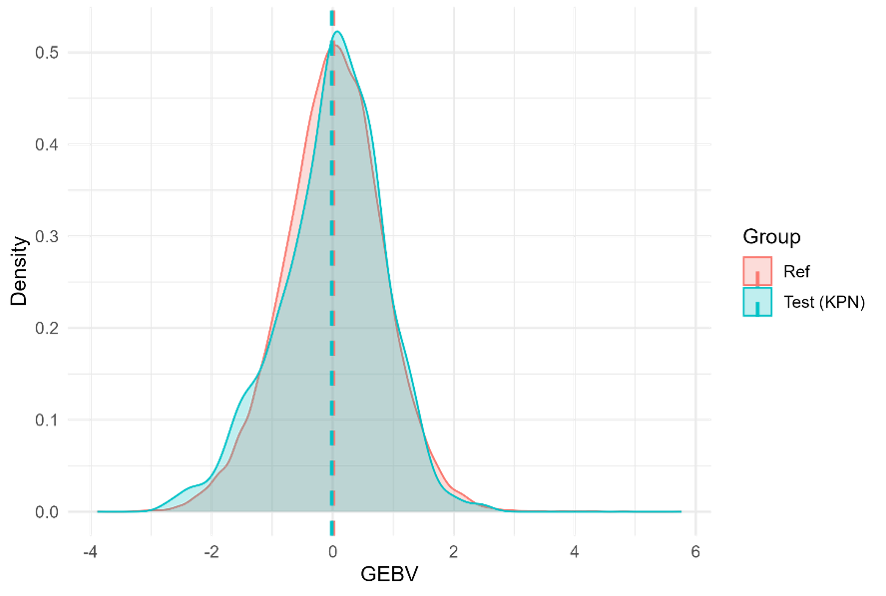
The accuracy of breeding value prediction was evaluated using prediction error variance (PEV). In genetic evaluation, prediction accuracy is commonly interpreted as the correlation between the true breeding value and its estimate. Because true breeding values are unknown, this correlation can be approximated using the additive genetic variance and the PEV. Accuracy was calculated from additive genetic variance and PEV. The usual expression is:
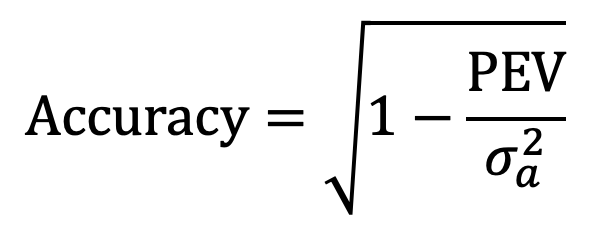
where σa2 is the additive genetic variance of the trait. This statistic provides a practical measure of the reliability of genomic breeding values in both the reference and KPN populations.
Genome-wide association study
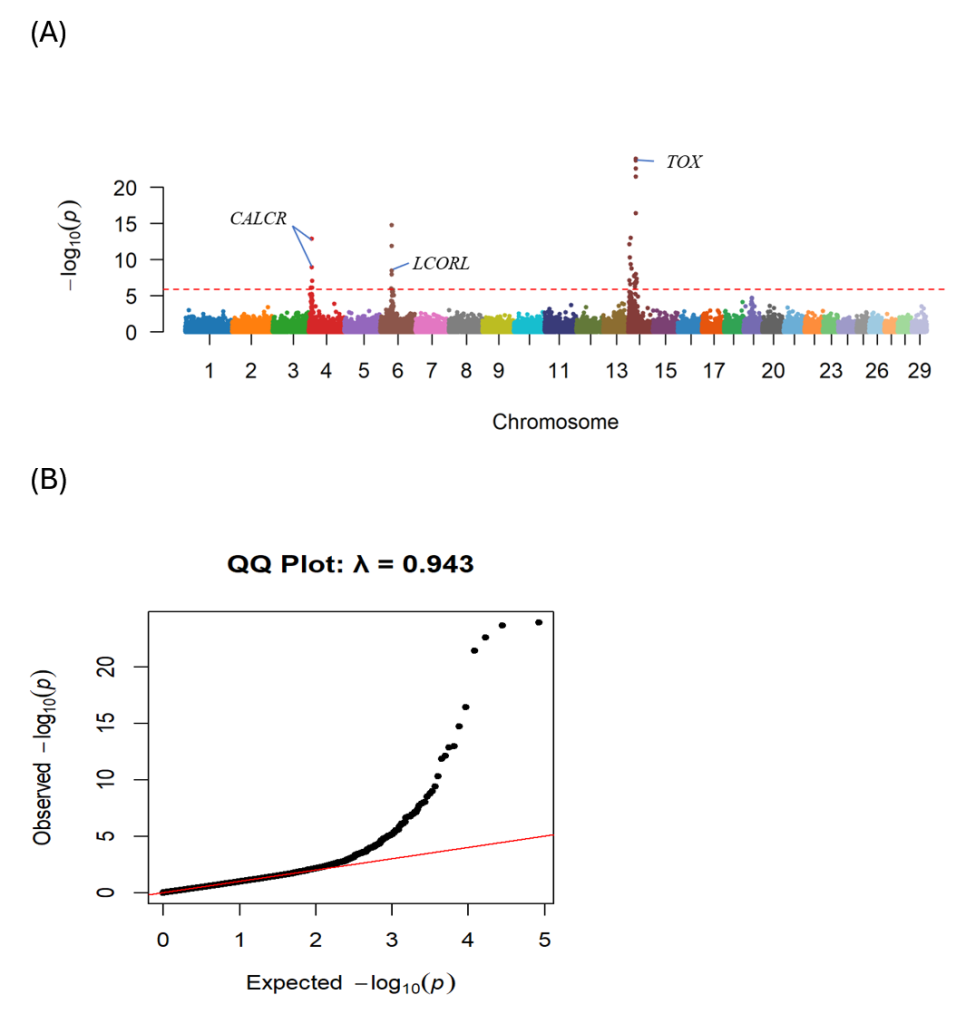
A genome-wide association study (GWAS) was performed to identify genomic loci associated with the CWA-derived carbon emission-related trait. Because the trait was analyzed in a structured population with related individuals, a linear mixed model was used to control for confounding due to relatedness and population structure. The model included fixed effects, the effect of the tested SNP, a random polygenic effect based on the genomic relationship matrix, and a residual term. This general model structure is consistent with mixed model GWAS commonly used in livestock populations.
The GWAS model may be expressed as:

where y is the vector of phenotypes for the carbon-related trait, b is the vector of fixed effects, a is the allele substitution effect of the tested SNP, S is the SNP genotype covariate, u is the vector of random polygenic effects assumed to follow N(0,Gσu2), and e is the vector of residuals assumed to follow N(0,Iσe2). Significant association signals were subsequently interpreted by examining nearby genes previously reported to be related to carcass growth, feed intake, or production efficiency.